Root Cellar by Charles Meyer, book cover
Horror · 10,987 words

Root Cellar

A Dead Man's Secret—And the Cost of Finally Opening It

Buy on Amazon — $4.97
Seventeen mismatched locks on a door in the kitchen floor. A letter from the man who spent forty years putting them there, one by one, left on the floor for whoever came next.

Gideon and Maura Edgerly have earned their quiet life — forty acres, white clapboard, stone foundation, the kind of silence a city never allows. What they haven't counted on is the cellar. Not what it contains: the stone walls are empty, the floor bare dirt, the shelves untouched. What the cellar does is the problem. It listens. It learns. And when the door comes open in the small hours of the morning, it speaks — in the voices of the people you've lost, with the exact details only grief holds close.

For Maura, it is her mother's voice: the warmth that Alzheimer's spent years erasing, suddenly restored. For Gideon, it is his father's voice: a half-finished birdhouse still in a vise, a detail he never told anyone, offered back to him from the dark like a key.

Root Cellar is a horror novel about the specific cruelty of loving something you cannot save — and about what happens when the dead are given a mouth. It traces three families across a century and a half of the same farmhouse, the same door, the same terrible arithmetic: a lock for every time you almost went down. Charles Meyer has written a story where the monster is not malice but intimacy, and where the only thing more frightening than the voice in the cellar is how much you want to believe it.

The door has been locked for a hundred and sixty years. Sooner or later, everyone who stands over it does the same calculation. So will you.

Don't open Root Cellar before bed. Open it knowing you will finish it — because once it calls you by name, you won't be able to put it down.

Stay updated from Charles Meyer

Get a short note when a new book is out.

Notify me

Read the opening

The GPS had stopped working three miles back, where the paved road gave way to gravel. Gideon Edgerly gripped the steering wheel as their sedan bounced through another pothole, the suspension groaning. Beside him, Maura pressed one hand against the dashboard, the other clutching the printed directions from the realtor.

“It should be just ahead,” she said. “Past the stone wall.”

The wall appeared through the bare November trees—fieldstone stacked without mortar, running parallel to the road before turning sharply inward. Gideon followed it, and the farmhouse emerged from the woods like something surfacing from deep water.

The photographs hadn’t lied, exactly. The clapboard siding was white, the foundation stone, the roof slate. But the pictures had been taken in summer, with the fields green and the maples full. Now the house stood surrounded by brown grass and skeletal branches, the nearest neighbor invisible beyond the tree line.

“Forty acres,” Gideon said, putting the car in park. “Just like we wanted.”

Maura didn’t answer. She was staring at the house, her fingers still pressed against the dashboard.

The front door key worked smoothly—the realtor had oiled the lock. Inside, the air smelled of dust and something else, something mineral and cold. Their footsteps echoed on the wide-plank floors as they moved through the empty rooms. The living room. The dining room. The kitchen.

Gideon stopped in the kitchen doorway.

The room was large, running the width of the house, with windows facing east and south. An old cast-iron sink stood beneath one window. A brick chimney rose through the center of the space where a wood stove had once been. And in the floor, between the chimney and the sink, was a door.

Not a trapdoor, exactly. More like a section of flooring that had been cut and fitted with iron hinges and a recessed handle. The wood was darker than the surrounding planks, worn smooth by use.

It traces three families across a century and a half of the same farmhouse, the same door, the same terrible arithmetic: a lock for every time you almost went down.
Visualise the story
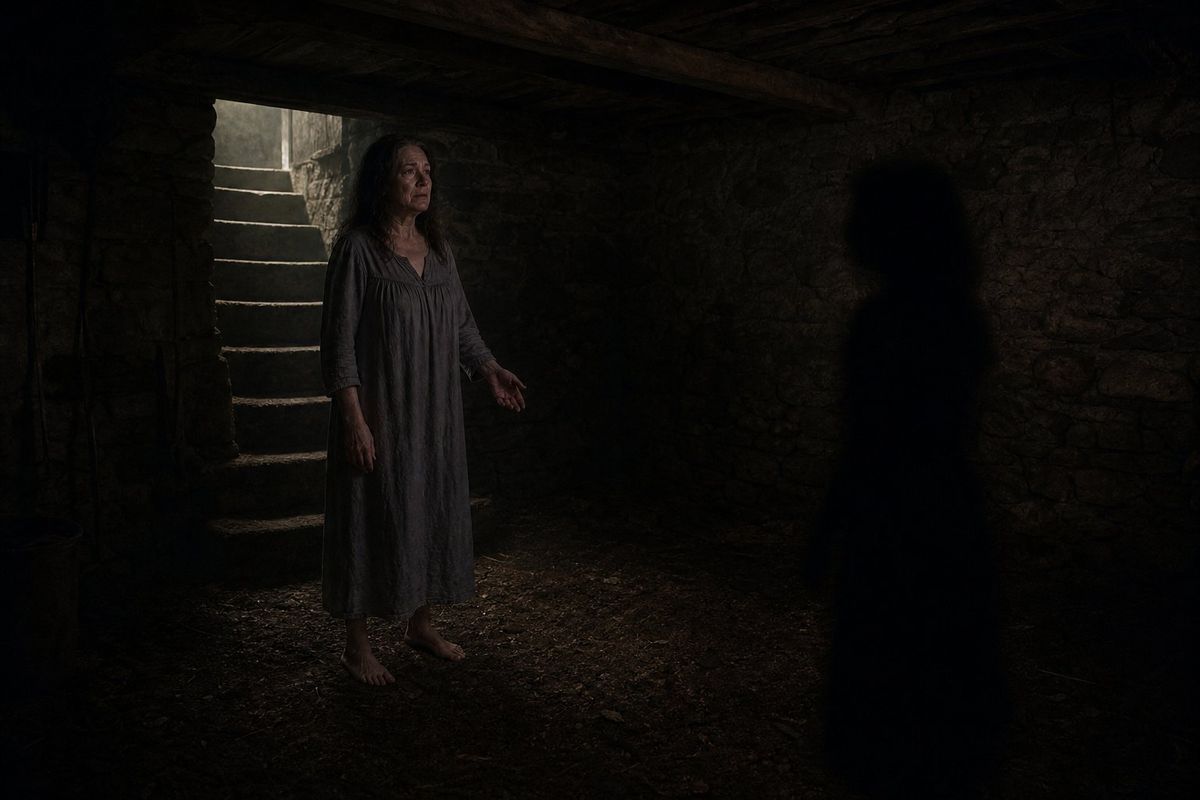
She heard her name. 'Maura.' The voice came from the cellar. Not loud—barely a whisper. But clear. Distinct. And it sounded like her mother.
The locks are for us, not for it—each one a morning I did not go down.
I know what you are," Maura said. Her voice didn't shake. She was surprised it didn't shake.
Click the play button below to watch the trailer
Characters and images are fictional. Any resemblance to real persons, living or dead, is coincidental.
$4.97
Kindle eBook · Read on any device
Buy on Amazon
Root Cellar — $4.97
Buy

More by Charles Meyer

📖

Preview
Chapters